The northern lights — aurora borealis — are the visible result of charged particles from the sun colliding with gases in Earth’s upper atmosphere. When these particles are funnelled towards the poles by Earth’s magnetic field and strike oxygen and nitrogen atoms, they excite those atoms to higher energy states. As the atoms return to normal, they release that energy as light — producing the greens, purples, pinks and reds we see in the sky. There are two primary solar events that send these particles our way.
Coronal Mass Ejection (CME)
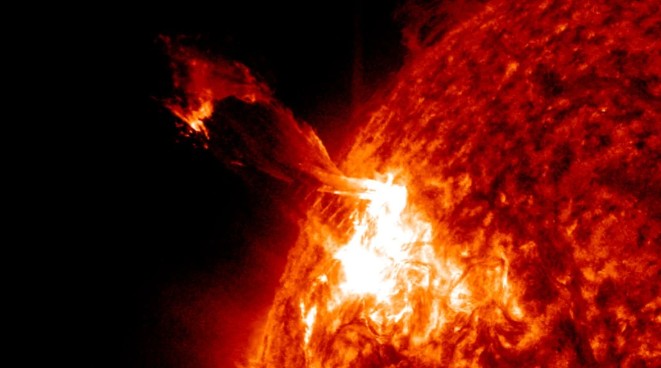
These are the big boys everyone looks for. CMEs are major discharges of solar particles (usually in concentrated and intense bursts) caused by a solar flare on the sun itself. The intensity of the flare generally dictates how intense the CME is, and in turn (if it does impact Earth), how intense the aurora appears on Earth. Solar flares are ranked by intensity (A,B,C,M, and X). A,B, and most C flares do not materially impact Earth or aurora viewing as these are too weak. Once into moderate or strong M flares, CMEs should be monitored for potential activity enhancement. Generally M flares/CMEs can cause Kp4 – Kp7 conditions, and if paired with other favorable conditions can result in beautiful shows. X-flares of any magnitude mean business if the associated CME is earth bound. X-flare CMEs (especially if paired with other favorable conditions) are the once a year or two type events that act like the ‘Superbowl’ for aurora chasers and photographers. CMEs are possible to predict in a rough sense, but exact timing (within 12 hours) is always very challenging. Usual time from Flare eruption to earth impact is between 36 and 80 hours. I get into much more detail about monitoring and predicting flares/CMEs, their aurora impacts, and exactly how to work these into a chase/photography shoot in my PDF guide and book.
Coronal Hole / Solar Wind
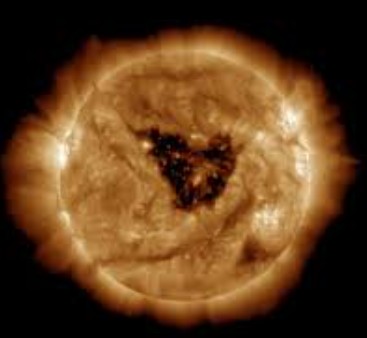
Coronal holes are generally weaker in terms of aurora enhancement then strong CMEs, but what they might lack in relative strength they can make up for in duration, aurora movement/dynamics, and especially in predictability. These ‘holes’ on the suns surface allow solar winds and particles to escape the sun at much higher velocities than normal levels. Normal solar wind speeds range between 300 – 400 km/second. Coronal holes can result in solar wind speeds of 500 – 800 km/second. As the earth is bombarded by particles at a higher than normal speed, more energy is released and you get enhanced aurora activity. Better yet, these are fairly predictable (even up to almost a month out; the time it takes for the sun to rotate). Between monitoring the official 27 day aurora forecasts (updates 1X week) and the current solar disk map, you can get a good idea of when above normal aurora activity will likely be present. Similar to CMEs, the travel time from when a coronal hole is positioned to impact earth (geoeffective and directly facing earth) until the impacts are felt is between 36 and 72 hours.